
Smart Car Features That Make Driving Safer
Cars have changed dramatically
over the years. They are no longer simply machines that take us from one place
to another. Modern vehicles are becoming smarter, more connected, and better
equipped to help drivers avoid accidents. While technology cannot replace an
attentive and responsible driver, smart safety features can provide valuable
support during everyday journeys.
From warning systems that alert
drivers about possible collisions to cameras that make parking easier, these
technologies are helping make driving safer and less stressful. Here are some
of the most useful smart car features changing the driving experience.
Automatic Emergency Braking
Automatic Emergency Braking,
often called AEB, is one of the most important safety technologies available in
modern cars. The system uses cameras, sensors, or radar to detect a possible
collision with another vehicle or object.
If the driver does not respond in
time, the car can automatically apply the brakes or increase braking force.
This can help reduce the impact of a collision and, in some situations, avoid
one completely. It is especially useful in busy city traffic, where sudden
stops are common.
Forward Collision Warning
Forward Collision Warning works closely
with automatic emergency braking. The system monitors the distance between your
car and the vehicle in front. If it detects that you are approaching another
vehicle too quickly, it can warn you through visual, sound, or vibration
alerts.
This gives the driver extra time
to react. Although it may seem like a simple feature, a quick warning can be
extremely useful when a driver is distracted by traffic, changing road
conditions, or unexpected movement ahead.
Blind-Spot Monitoring
Every driver knows that checking
mirrors is important, but traditional mirrors cannot show everything. This is
where blind-spot monitoring becomes useful.
The system uses sensors to detect
vehicles travelling in areas that may not be clearly visible in the mirrors.
When a vehicle is present in the blind spot, the driver receives a warning,
usually through a light near the side mirror.
This feature is particularly
helpful when changing lanes on busy roads and highways. It acts as an
additional set of eyes, but drivers should still physically check their
surroundings before moving.
Lane Departure Warning and
Lane-Keeping Assistance
Long drives can be tiring, and
even a small moment of inattention can cause a car to drift out of its lane.
Lane departure warning systems monitor road markings and alert drivers when the
vehicle begins moving out of its lane without an indicator being used.
Lane-keeping assistance takes the
technology one step further. It can provide gentle steering support to help
guide the vehicle back toward the centre of the lane.
These systems are useful for
reducing the risk of accidents caused by fatigue or distraction. However, they
are designed to assist the driver rather than take complete control of the
vehicle.
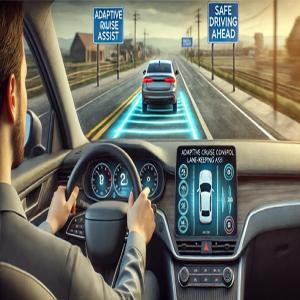
Adaptive Cruise Control
Traditional cruise control
maintains a set speed, but adaptive cruise control is much smarter. It can
automatically adjust the vehicle's speed to maintain a safe distance from the
car in front.
If traffic slows down, the system
can reduce your speed. When the road clears, the vehicle can accelerate back
toward the selected cruising speed. This can make highway driving more
comfortable while helping drivers maintain safer distances.
Rear-View Cameras and Parking
Sensors
Parking can be difficult,
especially in crowded areas. Rear-view cameras give drivers a clear view of the
area behind the vehicle, making it easier to identify obstacles, pedestrians,
and other cars.
Parking sensors provide
additional alerts when the vehicle gets close to an object. Some advanced cars
even offer 360-degree camera systems, giving drivers a complete view of their
surroundings.
These features are especially
useful for preventing low-speed accidents, which can easily happen in parking
lots and tight spaces.
Driver Attention Monitoring
Driver fatigue is a serious
concern, especially during long journeys. Some modern vehicles now include
driver-monitoring systems that analyse steering behaviour, eye movement, or
driving patterns to detect signs of tiredness or reduced attention.
If the system believes the driver
needs a break, it can provide an alert or suggest stopping. While the
technology cannot determine every situation perfectly, it can serve as an
important reminder to rest when needed.
The Future of Safer Driving
Smart car technology is making
driving safer, but it is important to remember that these features are support
systems. They cannot replace responsible driving, awareness, or following
traffic rules.
The s
afest combination is still a
careful driver supported by intelligent technology. As vehicles continue to
become more connected and advanced, smart safety features will likely become
even more common. The future of driving may be more automated, but for now,
these technologies are helping drivers feel more confident, informed, and
protected on the road.
TAGS : smart car features, smart car safety features, car safety features, modern car technology, advanced car safety, car safety technology, smart vehicle technology, latest car technology, car features 2026, best car safety features, automatic emergency braking


